

The Property Type Written on a Title Deed in Turkey: The Legal Rules on Condominium Ownership, Occupancy Permits, Zoning and Tiny House Use
The most common mistake in real estate law in Turkey and in property purchase and sale transactions is to assume that the right of ownership consists only of the visible name on the title deed or of the actual situation of the property on the ground. In reality, the absolute legal protection of a property, its potential to gain value and the legal limits on its use, are directly tied to the property type entered in the land register. The land registry classification on a title deed is the most basic and binding legal indicator that draws the boundaries of the real right over the property. Under Turkish law, actual uses and outside circumstances that conflict with this entry can cause legal problems.
Both the occupancy permit uncertainties that arise during the conversion from construction servitude to condominium ownership and the uses that conflict with the property type registered on the title deed, such as the tiny house (mobile home) units that have recently become widespread on properties designated as agricultural land or as a building plot, create legal, administrative and financial risks that are hard to undo for buyers. Because the only valid basis is the official property type on the title deed where the actual situation on the ground conflicts with the land registry record, any use that runs against that basis ends in demolition orders, administrative fines and sanctions for unlicensed construction in Turkey.
Accordingly, the essential differences between title deeds with a construction servitude and title deeds with condominium ownership, the occupancy permit’s decisive effect on registration, and all the legal consequences under the legislation of temporary or fixed building uses that conflict with the land registry classification of the property rest on binding rules.
Why Does the Property Type on a Title Deed Matter in Turkey?
The property type written on a property’s title deed in Turkey is the official registry entry showing what type of thing that property is recorded as in the land register; in practice it is referred to as “vasıf” or “cins”.
Independently of the way it is actually used, the type recorded on a property’s title deed in Turkey directly determines the limits of the ownership powers that may be exercised over that property, the administrative supervision regime and the public law restrictions that apply to it in Turkey.
- Saleability and divisibility (subdivision / sale in shares): This shows whether the property is subject to minimum parcelling and subdivision conditions and whether a ban on share sales or pre-emption rights apply.
- Development regime: This determines whether construction may lawfully be carried out on it, whether temporary or permanent housing may be established, and whether a construction permit can be obtained.
- Financial and tax regime: This sets the property tax base, the amount of the charges, the tax exemption rules and the periodic declaration obligations that apply to it.
- Basis of expropriation compensation: This determines the method used to calculate the compensation payable in expropriation proceedings carried out on a public interest decision (the comparable sales method for a development plot / the net income capitalisation method for agricultural land).
What Does the Property Type Written on a Title Deed Mean in Turkey?
The property classification is the entry showing what type of thing that property is recorded as in the land register. The property type is part of the property’s identity; it appears on the title deed together with the block, parcel, surface area and location details.
Under Turkish law, the legal function of the property type is not limited to describing the property. The land registry classification is the first and most basic indicator determining which legal regime will apply to the property:
- Farmland: This is subject to the land protection, minimum parcel size and prohibition on division regime of the Soil Protection and Land Use Law No. 5403.
- Building plot: This is subject to the development, subdivision and consolidation conditions of the Zoning Law No. 3194 and the related zoning regulations in Turkey.
- Independent unit under flat ownership / floor easement: This becomes subject to the flat ownership, common areas and management regime of the Condominium Law No. 634.
How Is the Property Type Shown in the Land Register in Turkey?
A separate page is opened in the land register for each property, and the property type of that property is shown in the relevant box on that page. In practice, the three terms used for this concept mean the same thing:
- Nitelik: This is the official legislative wording used on the title deed and in the register.
- Vasıf: This is the equivalent commonly used in legal doctrine and in practice.
- Cins: This is the term that gives its name to the procedure for changing the property type (the expressions “cins değişikliği” and “cins tashihi” come from it).
A note on old land registry records:
In older land registry records, the property classification may be written using wording that differs from today’s terminology. Especially in records dating back to the Ottoman period, the land types (arazi-i miriyye, mülk arazi and so on), units of measurement and boundary descriptions are subject to an entirely different legal system. Claims based on records of this kind require a specific legal examination in Turkey as regards the transfer of Ottoman title deeds by inheritance and the determination of who holds the right.
What Property Types Exist on a Title Deed in Turkey?
The property classifications encountered in the land register fall into three main groups according to the legal regimes they are subject to:
1. Which Properties Are Designated as Land in Turkey?
Properties such as a field, a vineyard, a garden, an olive grove, a hazelnut grove, a meadow, a pasture and raw soil fall into this group. All of these properties are areas that fall outside the zoning plan or that are allocated to agricultural production. Properties designated as agricultural land are subject to the strict protection, minimum parcel size and prohibition on division regime of the Soil Protection and Land Use Law No. 5403.
2. Which Properties Are Designated as a Building Plot in Turkey?
These are properties that have been brought within the scope of a zoning plan, whose parcelling procedures have been completed in line with the zoning legislation, and that have been made suitable for construction. Under Turkish law, the building plot property type is a legal consequence of the zoning plan approved by the competent authorities and of the parcelling (application of Art. 18 and similar) procedures.
3. Properties Designated as a Building or an Independent Unit in Turkey
Properties on which construction has been completed or is ongoing are recorded in the register under Turkish law with property types such as “masonry house”, “reinforced concrete apartment building”, “workplace”. Depending on the legal regime established over the independent units of a building, the land registry record contains the words construction servitude or condominium ownership. These two entries point to two separate stages showing the physical and legal state of completion of the building.
4. Special Regimes and Complementary Legal Elements in Turkey
- Specialised regimes: In addition to these, special regimes of obligations and property law such as “timeshare”, “land share” and “independent and permanent right of superficies” are also shown in the land registry record with their own particular wording.
- Annotations and declarations: In addition to the land registry classification of the property, the annotations and declarations box in the land registry record must also be examined in detail in order to establish the restrictions, rights and obligations recorded in the land register.
- Acquisition of property by foreigners: The property type also works as a decisive legal filter (for example, the obligation to submit a project for properties designated as land without a building on it) where foreign individuals and legal entities acquire real estate in Turkey.
Is the Property Type on a Title Deed the Same as the Actual Situation in Turkey?
The property type written on a property’s title deed and the actual situation of the property are not the same thing, and in practice the two often diverge. The land registry classification reflects the legal position on the date the record was made; a later change in the actual situation of the property is not reflected in the register automatically. For this reason, a property that has had a building on it for years may still appear on the title deed as a “field”, and a parcel brought within a zoning plan may still appear as a “vineyard”.
The wording in the “property type” box of the land registry is an important element in establishing the legal position of the property in the land registry. For this reason, the fact that a property is registered on the title deed as a “land plot”, “field”, “building”, “dwelling” or under another property type should not be treated as a merely technical piece of land registry information.
Under Turkish law, the property type (vasıf) written on the title deed is an important indicator that calls for the legal and the actual position of the property to be assessed together. Where there is a building on the property in particular, whether the property type in the land registry record and the actual use of the property are consistent with each other must also be examined.
Does the Property Type on a Title Deed Determine Actual Use in Turkey?
The property type on the title deed is the presumption showing how the property may lawfully be used under Turkish property law; on its own, however, it is not decisive. The purpose for which a property may be used is determined less by the land registry record than by the position of that property in the zoning plan and the special legislation it is subject to:
- The word “building plot” on the title deed: This does not mean that you may build on it to whatever extent you wish. It is subject to the floor area ratio (KAKS), the ground coverage ratio (TAKS), and the height and setback restrictions in the zoning plan.
- The word “field” on the title deed: Where the property has been brought within the scope of a zoning plan, the mere fact that the record says field does not mean that it remains subject to the agricultural land regime.
How Is the Actual Situation Reflected in the Land Registry Record in Turkey? (Change of Land Type / Cins Tashihi)
Any inconsistency between the actual situation of the property and the property classification in the land registry record is resolved by a change of land type (cins değişikliği). A change of land type means altering the property type registered for a property in the register so as to bring it into line with its new situation (for example, converting farmland into a development plot, or converting a development plot into a masonry apartment building because of the building erected on it).
- It creates nothing new, it registers: A reclassification does not on its own create any zoning or use permit; it consists only of entering in the register a legal and factual change that has already taken place. Before arable land can be converted into a building plot, the zoning plan must first have been made and the parcelling completed; the reclassification is the last link in that process, not its beginning.
- Ease of an automatic change of land type: Under the amendment made to Art. 10 of the Condominium Law No. 634 by Law No. 7327, the change of land type procedures for buildings for which an Occupancy Permit (iskan) has been issued are carried out automatically upon the registration notification sent by the relevant authority to the land registry office.
When Does a Conflict over the Property Type Produce Legal Consequences in Turkey?
The difference between the property type on the title deed and the actual situation shows its most concrete and most serious consequences in proceedings to determine expropriation compensation. In expropriation law, the valuation methods applied to a land plot and to land (a field) rest on entirely different principles:
- For properties designated as a building plot: Under Art. 11/1-g of the Expropriation Law No. 2942, the sale value based on comparable sales before the date of expropriation is taken as the basis.
- For properties designated as land: Under subparagraph 1/f of the same article, the net income the property would produce if used as it stands, according to its location and conditions on the date of expropriation, is taken as the basis.
In practice, the expropriation compensation figures calculated under the two methods differ many times over.
The Principle of the Property’s Actual Classification in Court of Cassation Case Law
In determining expropriation compensation, the Court of Cassation does not confine itself to the land registry record alone; it takes as its basis the actual (factual and legal) property classification of the property on the date of expropriation.
The decision of the Court of Cassation 5th Civil Chamber, Case No. 2022/8781, Decision No. 2023/4254, dated 02.05.2023 is a concrete example of this approach. In that decision, the location of the property, its features as set out in the expert report, the letters of the relevant mayor’s office and comparable decisions of the Chamber concerning nearby properties were assessed as a whole, and it was held that the properties in dispute had to be accepted as having the property type of a development plot. Giving judgment on the basis of an expert report that classified the property as land by looking at the land registry record alone and set the value under the net income method was expressly held to be a ground for reversal.
This settled case law shows that a “field” entry in the land register does not by itself condemn the owner to a low figure. In practice, however, many rightholders in expropriation cases fail to prove that the property has acquired the property type of a building plot in fact and in law (that it benefits from municipal services, that it is surrounded by a residential area, that it falls within a zoning plan and so on), because they do not put the supporting evidence before the court, and so lose properties that are in truth worth building plot values at land values.
What Is the Difference Between Farmland and a Building Plot in Turkey?
The basic difference between farmland and a land plot is not physical or geographical but a difference of legal status under Turkish law. Of two properties of the same size, lying side by side and topographically identical, one may be a land plot in law and the other farmland. The main factor determining the distinction is whether the property falls within an implementation zoning plan and whether its parcelling has been carried out.
What Does a Building Plot Mean in Turkey?
In terms of the zoning legislation in Turkey, a building plot is a property that may be built on and whose development conditions are set by the zoning plan. In assessing whether a property is classified as a building plot, not only the wording in the land registry record but also the zoning plan, development conditions and parcelling situation in the area where the property lies must be taken into account.
Important note: The word “building plot” on the title deed does not mean that unlimited construction, or construction of any kind, is automatically possible on the property. To establish whether development is actually possible, the current zoning status and the zoning certificate of the parcel must be checked separately with the relevant municipality.
What Does Farmland Mean in Turkey?
Farmland is essentially a property used for agricultural purposes or having an agricultural character. The basic rules on the protection and use of agricultural land are contained in the Soil Protection and Land Use Law No. 5403.
A property with the land registry classification “field” on the title deed does not acquire the property type of a building plot by itself merely because it is empty, lies close to a settlement area or has development around it. In determining the property classification of a property, its position in the zoning plan, its agricultural character and the legislation it is subject to must be assessed together.
Under What Conditions Is a Property Treated as a Building Plot in Turkey?
As a rule, two basic conditions must be met together before a property can acquire the legal status of a development plot:
- Falling within the boundaries of a zoning plan: The property must lie within the boundaries of an implementation zoning plan (at a scale of 1/1000) approved by the competent authority (the municipality or the special provincial administration). A zoning plan is the administrative act setting the function of the area (housing, commerce, industry, green space and so on) and the development conditions (floor area ratio, height and so on).
- Carrying out the parcelling (zoning application) procedure: The property must have been made subject to land and development plot arrangement under Art. 18 of the Zoning Law No. 3194. By this procedure the raw cadastral parcel is converted, in law and in fact, into a zoning parcel.
What Are the Legal Differences Between a Building Plot and Farmland in Turkey?
The distinction between a building plot and arable land is not limited to the property type shown on the title deed; under Turkish real estate law it produces the following basic legal and practical consequences as regards the purpose for which the property may be used, the possibility of building on it, its division and the financing available for it:
- Applicable legislation: The development position of a land plot is assessed essentially within the framework of the Zoning Law No. 3194 and the provisions of the relevant zoning plan, whereas for agricultural land the provisions of the Soil Protection and Land Use Law No. 5403 govern.
- Possibility of building: On a building plot, development is possible within the framework of the zoning plan the property is subject to and the applicable development conditions. On agricultural land, by contrast, there are special restrictions aimed at protecting the agricultural character of the land; building a dwelling or any other structure on farmland without obtaining the necessary administrative permits is not legally possible.
- Division of agricultural land (subdivision restriction): Agricultural land cannot be divided in a way that conflicts with the minimum size limits laid down in Law No. 5403. For this reason, splitting arable land into small pieces and allocating them in practice to different people (hobby gardens, use in shares and so on) does not create separate new parcels in the land register.
- Credit and financing options: In the lending policies of banks, properties designated as farmland and properties designated as a development plot or a dwelling are not subject to the same criteria. It should not be assumed that a property registered on the title deed as “field” qualifies for a housing loan; before the transaction, its credit position must be confirmed with the financial institution.
How Is a Property Designated as Farmland Converted into a Building Plot in Turkey?
Converting farmland into a land plot is not a simple procedure completed with a single petition or application; it is a long process made up of successive legal and administrative stages:
CONVERSION OF FARMLAND INTO A BUILDING PLOT IN TURKEY
├── 1. Inclusion in a zoning plan (automatic decision of the authority or plan amendment)
├── 2. Permit for non-agricultural use (Board decision under Law No. 5403)
├── 3. Parcelling procedure (application of Art. 18 of Law No. 3194 / subdivision and consolidation)
└── 4. Change of land type (registration of the reclassification in the land register)
- Inclusion in a zoning plan: This is the bringing of the area in which the property lies within the scope of a zoning plan by the authority. This does not depend on the owner’s request alone; it depends on the public interest and the planning discretion of the authority.
- Permit for non-agricultural use: Before a property designated as agricultural land can be opened to development, a permit must be obtained under Law No. 5403 from the Soil Protection Board and the relevant Ministry authorities.
- Parcelling: This is the procedure by which a cadastral parcel becomes a zoning parcel after the public transfers have been made.
- Change of land type: This is the final step in the land registry once the administrative processes are complete; the property type is updated in the register as “building plot”.
Completing this process may take years, and there is no legal guarantee that every stage will end favourably. For a significant proportion of the arable land sold on the property market with promises that it “will soon be opened to development” or “will be converted into a development plot”, the authority has not even begun any concrete zoning work.
Requesting an official zoning status certificate from the Directorate of Zoning and Urban Planning of the relevant municipality before deciding to buy removes speculative financial risks of this kind in Turkey.
What Does the Farmland and Building Plot Distinction Change for Taxes and Charges in Turkey?
A land plot and land (a field) are subject to entirely different rates, to different square metre unit values set by the assessment commissions, and to different minimum tax base criteria under the property tax regime.
As a rule, the unit value of a development plot for property tax purposes is markedly higher than that of farmland or land in the same area. This directly affects both the annual property tax paid every year and the tax base of the land registry charge paid on transfer.
An exception in tax law (Property Tax Law No. 1319):
For tax law purposes, land within municipal boundaries that has been parcelled by the municipality counts as a development plot. For this reason, even where a property is still registered in the land register as a “field”, it may be taxed as a development plot under the Property Tax Law according to its zoning and parcelling status.
Under the Property Tax Law No. 1319, the tax rates differ according to the type of the property and the administrative boundaries in which it lies (metropolitan city / non-metropolitan city):
- Minimum tax base limit: The sale price declared on transfer cannot be lower than the Property Tax Value (current market value) of the property for that year, obtained from the relevant municipality.
- Because the current market values of properties designated as a building plot are far higher than those of arable land, the minimum land registry charge payable on the transfer of a land plot is also markedly higher.
In practice, it is extremely common to declare the sale price at the land registry at the level of the current market value or below the actual sale price in order to reduce the charge. Under Turkish law, however, this practice carries serious sanctions:
- Financial and criminal sanctions: Where the difference is identified in examinations carried out by the Revenue Administration on the basis of bank transfers or valuation reports, the underpaid charge is collected and a tax loss penalty and default interest are imposed on top of it.
- Legal risks: A low sale price shown at the land registry is accepted by the courts as a strong presumption that the transaction was collusive in cases based on a defect in consent or on collusion by the deceased (concealing assets from the estate).
Can Any Building Be Erected on a Property Designated as a Building Plot in Turkey?
The word “land plot” in the land register or on the title deed does not give the owner an unlimited right to build in whatever way it wishes. Under Turkish law, the land plot classification only shows that the property has been made legally suitable for construction. The document determining how large a building, of how many storeys and with what function (housing, commerce, industry and so on) may be erected on a development plot is not the title deed but the zoning plan and the plan notes approved by the competent authority.
What Parameters Determine the Development Conditions in Turkey?
Under Turkish law, the limits of the building that may be erected on a parcel are drawn by the technical parameters set out in the relevant zoning plan. Those parameters are as follows:
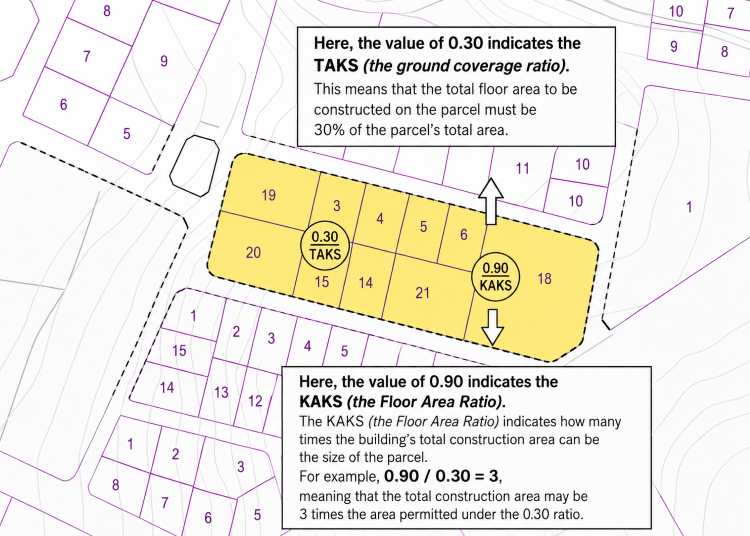
- TAKS (ground coverage ratio): The footprint of the building on the ground.
- KAKS / emsal (floor area ratio): The total construction area.
- Height / number of storeys (Yençok): The maximum number of storeys the building may have, or its height in metres.
- Building layout: Detached, block or terraced layout.
- Setback distances: The gaps that must be left from the front, side and rear garden.
These conditions differ from parcel to parcel. Of two adjacent building plots on the same street and of the same surface area, one may take a 3-storey dwelling while an 8-storey building on the other is entirely lawful and ordinary because of its zoning function. For this reason the true value of a development plot depends less on its surface area than on the total net saleable or usable construction area (the floor area ratio) that may be built on it.
Zoning status certificate (zoning certificate): The current zoning function and development conditions of a parcel are established by the official Zoning Status Certificate obtained from the relevant municipality in Turkey.
What Is TAKS (the Ground Coverage Ratio) in Turkey?
TAKS (the ground coverage ratio) is the ratio, in Turkish zoning law, of the footprint of the building on the ground to the total area of the zoning parcel.
- Example calculation: If TAKS is 0.30 on a parcel with a surface area of 1,000 square metres, the footprint of the building on the ground may be at most 300 square metres. The remaining 700 square metres of the parcel must be left open as garden, parking and setback distance.
- Legal limit: Under the Zoning Regulation on Planned Areas, in areas where a detached or block layout applies and unless the implementation zoning plan provides otherwise, TAKS cannot exceed 40% (0.40). (This limit was updated by the amendment to the Regulation published in the Official Gazette of 1 July 2026).
What Is KAKS (the Floor Area Ratio) in Turkey?
KAKS (the floor area ratio, emsal) is the ratio of the sum of all the storey areas to be built to the area of the zoning parcel under Turkish legislation. While TAKS limits the width of the building on the ground, KAKS limits the total enclosed construction area of the building.
- Example calculation: If KAKS is 1.50 on a parcel with a surface area of 1,000 square metres, the total enclosed area of all the storeys that may be built on the parcel may be 1,500 square metres at most.
- Distribution over storeys: How that 1,500 square metre area is distributed over the storeys is designed according to the TAKS value, the setback distances and the maximum height (number of storeys / Yençok) limits.
Floor Area Ratio Calculation and Excluded Areas in Turkey
Which areas are included in the floor area ratio calculation and which are deducted from the net construction area (areas excluded from the ratio) is one of the technical questions that gives rise to the most disputes in real estate and construction law in Turkey.
- Legislative framework: The Zoning Regulation on Planned Areas sets out in detail the conditions on which areas such as shelters, car parks, plant rooms and fire escapes are excluded from the ratio.
- The latest amendment to the Regulation: By the amendment to the Regulation of 1 July 2026, certain open landscaping elements in the garden and certain common areas were also excluded from the ratio within set proportions.
- The importance of the permit date: For this reason, at the architectural design and permit stage the floor area ratio must be calculated according to the text of the Regulation in force on the date the building permit is applied for.
How Are the Number of Storeys and the Setback Distance Determined in Turkey?
The number of storeys and the height of the building may be shown directly in the zoning plan, and are also limited indirectly through the floor area ratio (KAKS) and TAKS figures. The height of a building means the vertical distance from the point at which the building takes its level (the plinth level or the road level) up to the eaves. In zoning plans it is usually stated as Yençok (the maximum building height) or as a limit on the number of storeys.
The setback distance, on the other hand, consists of the boundary lines showing how close the building may come to the road and to the neighbouring parcels:
- Front garden distance: As a rule this is at least 5 metres from the road (unless the zoning plan provides otherwise).
- Side and rear garden distances: As a rule these are at least 3 metres; as the height of the building or the number of storeys increases, this distance is increased by set amounts for each storey (usually 0.50 m).
Breaching the setback distances means that the project cannot obtain a permit, or, if one has already been obtained, leads to the cancellation of the permit and to the ground coverage (TAKS) calculation becoming legally invalid in Turkey.
Can Construction Begin Without a Construction Permit in Turkey?
Starting construction without obtaining a construction permit in Turkey is prohibited. Under Art. 21 of the Zoning Law No. 3194, in all areas falling within the scope of the Law, for the buildings to be erected, from the relevant authority (the municipality or the governorship) a Construction Permit must be obtained. A construction permit is the official document proving that the compliance of the project with the zoning plan, with the Zoning Regulation on Planned Areas and with the earthquake and shelter regulations has passed public inspection.
1. Stopping and Sealing the Building, and Demolition (Zoning Law No. 3194 Art. 32)
Where it is established that construction has begun without a permit or in breach of the permit:
- Under Turkish law the building is immediately stopped and sealed by the relevant authority.
- A works stoppage report is drawn up and the breach is annotated or declared in the declarations box of the land register.
- The owner of the building is given at most 1 month to remedy the breach or to obtain a permit.
- If the breach is not remedied or a permit is not obtained within that period, the municipality or the governorship orders the demolition of the unlicensed or non-compliant building.
2. Administrative Fine (Zoning Law No. 3194 Art. 42)
Under Art. 42 of Law No. 3194, an administrative monetary fine is imposed on the basis of the ground area of the illegal building, the class and group of the building and the nature of the breach of the zoning legislation.
- The amounts of the fines are updated each year by the revaluation rate.
- Where the environment or the safety of life and property is threatened, in conservation areas or in cases of unlawful occupation, the amount of the penalty is increased several times over; in the event of repetition the administrative penalties are applied at multiplied rates.
3. Other Legal and Practical Risks in Turkey
An unlicensed building, or one built in breach of its permit, does not face administrative sanctions alone:
- Obstacle to the habitation certificate and flat ownership: No Occupancy Permit (iskan) can be obtained, and no condominium title can be issued for the independent sections.
- Obstacle to financing: Banks will not lend against it and it cannot pass their valuation processes.
- Obstacle to utility connections: Connecting basic utility subscriptions such as electricity, water and natural gas becomes impossible (apart from the exceptions in the transitional provisions).
- Criminal liability: Under Art. 184 of the Turkish Penal Code (TPC), criminal proceedings are brought against those who build, or have built, a building without a permit, seeking a prison sentence (the offence of causing zoning pollution) of between 1 and 5 years.

Can a Building Be Erected on a Property Designated as Farmland in Turkey?
As a rule, a building cannot freely be erected on a property designated as farmland. The Soil Protection and Land Use Law No. 5403 is founded on the absolute protection of agricultural land and on its not being used for any purpose other than its own; it allows only very limited exceptions to that rule.
The procedures and principles governing construction on agricultural land and the permit processes were the subject of a critical legislative update in Turkey not long ago:
- The new Regulation period: The Regulation on the Protection and Use of Agricultural Land, published in the Official Gazette No. 33214 of 4 April 2026 and thereby brought into force, repealed the earlier regulation of 2017.
- A practical note: For this reason, the conditions and procedures set out in older sources based on the repealed regulation of 2017 must not be relied on in relation to construction on agricultural land, vineyard house permits and non-agricultural use procedures.
When Is a Permit for Non-Agricultural Use Granted in Turkey?
Before any construction or facility for a non-agricultural purpose can be put on agricultural land, a Permit for Non-Agricultural Use must be obtained from the Ministry of Agriculture and Forestry or from the authorised Provincial Directorates of Agriculture and Forestry. Permit applications are put through the filters, under Turkish legislation, laid down in the Regulation in force:
- The class of the land: On absolute agricultural land, special crop land and planted agricultural land, a permit is extremely difficult to obtain and is assessed within a far narrower framework than on marginal agricultural land.
- Public interest and alternative areas: The board examines of its own motion whether the project serves the public interest and whether any other non-agricultural alternative area (marginal land or a zoning parcel) exists for the facility in question.
What Rules Apply to Agricultural Buildings in Turkey?
Buildings that serve the agricultural production of the land itself do not count as “non-agricultural use” and are subject to a special legal regime.
Under the Regulation in force, buildings such as greenhouses, cold storage units, livestock facilities (dairies, poultry houses and so on) and a vineyard house or caretaker’s house are treated as falling within the scope of an agricultural building in Turkey.
The practical risks encountered with agricultural buildings, and the widespread “vineyard house” misconception, lead to serious administrative and legal sanctions because of construction that breaches the legislation.
- The permit and licence requirement: Falling within the definition of an agricultural building does not mean that the building may be erected entirely freely. An opinion of compliance must be obtained from the relevant Provincial Directorate and a building licence must be issued under the Zoning Law No. 3194.
- The risk of use outside the stated purpose: The most frequent legal mistake in practice is obtaining a permit under the heading of a “vineyard house / agricultural storage” and then erecting villas or buildings amounting to permanent housing on the property. Once the requirement that the building serve agricultural activity falls away, or the limits of the permit are exceeded, the building becomes unlicensed construction. Under Turkish law this brings the risk of demolition under Art. 32 of the Zoning Law, an administrative fine under Art. 42, and criminal proceedings for the offence of causing zoning pollution under Art. 184 of the TPC.
Important note: Obtaining the permit required for non-agricultural use does not by itself provide a construction permit or a direct right to build. Before the building can lawfully be erected, the applicable zoning and development conditions under the Zoning Law No. 3194 must also be met and a construction permit must be obtained from the competent authority (the municipality or the special provincial administration).
What Is the Sanction for an Unauthorised and Illegal Building on Farmland in Turkey?
For buildings erected on agricultural land without permission, a double sanction regime operates under both the agricultural legislation and the zoning legislation.
1. Sanctions Under Law No. 5403 (Agricultural Legislation)
For those who allocate agricultural land to non-agricultural use without a permit, or who erect a building on it without permission:
- Administrative fine: Under the Soil Protection and Land Use Law No. 5403, an administrative monetary fine is imposed on the basis of the area of the land damaged and its class.
- Obligation to restore the land: The authority gives the owner of the building a period in which to restore the land to its former state, fit for agriculture. If the land is not restored within the period allowed, the governorship clears it and restores it to its former state and the costs are recovered from the person responsible.
2. Sanctions Under Law No. 3194 (Zoning Legislation)
Because the building is at the same time unlicensed (an illegal building):
- Sealing and demolition (Art. 32): The building is stopped and sealed immediately. For buildings of this kind, which cannot be brought under a permit within the statutory period, a demolition order is issued automatically.
- Administrative fine (Art. 42): An administrative penalty calculated on the class, group and area of the building is imposed.
A note on annual updates: Because the administrative fines imposed under both Law No. 5403 and Law No. 3194 are increased each year by the revaluation rate, the actual amounts to be applied must be calculated on the current coefficients at the date of the act and the transaction.
3. Restrictions on Utility Subscriptions and Infrastructure Cut-Offs in Turkey
Under the legal arrangements introduced by Law No. 7584, and in order to combat illegal construction, the supply of basic infrastructure services and subscriptions such as electricity, water and natural gas to unlicensed or unauthorised buildings has been made subject to extremely strict conditions and limited by criminal sanctions.
- Ban on subscriptions and the first-connection penalty: Connecting electricity, water and natural gas to unlicensed or unauthorised buildings is absolutely prohibited. Authorities, institutions and distribution companies that act in breach of this ban and provide a subscription are fined 100,000 TL for each subscriber.
- Obligation to cancel and successive monthly penalties: Where the non-compliant subscription is not cancelled within 30 days of service of the administrative monetary fine, a further administrative monetary fine of 100,000 TL for each month in which the subscription continues is applied.
4. Serious Legal and Financial Consequences in Turkey
Under Turkish law, the most serious consequence of an unauthorised building is often not the administrative fines imposed but:
- The fact that the building can never be brought under a permit and an occupancy permit,
- The fact that no correction of the land type can be made at the land registry, so condominium ownership cannot be reached,
- The fact that, because of the illegal construction on it, the property loses its saleability, its eligibility for credit and its commercial value in legal terms.
Can a Share in Farmland Be Sold in Turkey?
A share sale in farmland is not absolutely prohibited; it is possible, however, only within the limits allowed by the prohibition on division introduced by the Soil Protection and Land Use Law No. 5403. Two mistaken beliefs are widespread on this point in practice: The assumption that a share sale in farmland “can never be done” and the misconception that it “can be done freely in all circumstances” . The legal regime lies between these two extremes and rests on the principles of a minimum parcel size and a ban on increasing the number of co-owners.
What Is the Minimum Indivisible Size Rule? (Art. 8 of Law No. 5403)
Under Art. 8 of Law No. 5403, agricultural land that has reached the minimum sizes set out in the legislation acquires the character of an indivisible thing.
Agricultural land that is an indivisible thing cannot be subdivided, cannot be split into shares and cannot be transferred in a way that increases the number of shares and co-owners below the following limits. (Sale and transfer transactions involving Treasury property are a specific exception to this ban).
The minimum agricultural land sizes laid down in the Law are as follows:
In What Cases Is a Sale in Shares Possible in Turkey?
The purpose of the Law is to prevent agricultural land from shrinking and the number of co-owners from growing. Accordingly, the following legal principles apply to transfers:
- Transfer of a share between co-owners: Where one co-owner transfers the whole of its existing share to another co-owner, this is not treated as falling within the ban, because it reduces or preserves the number of co-owners.
- Splitting a share on transfer or adding a new co-owner: Splitting an existing share and selling it to more than one person, or adding a new co-owner from outside so as to create new shares below the minimum size, is strictly prohibited.
- Sale of the property as a whole: Transferring the whole of the farmland (as a 1/1 share) to a single buyer, even if it is held in shares, is legally possible because it creates no new division and no increase in the number of co-owners.
In the practice of the General Directorate of Land Registry and Cadastre, where any doubt arises over a request for a sale of a share, an official opinion is obtained from the relevant Provincial or District Directorate of Agriculture and Forestry before the transaction is carried out. Checking this filter at the Land Registry Office before buying is a practical necessity in Turkey.
Where a dispute arises between co-owners and proceedings to dissolve the co-ownership are brought, the court cannot order division in kind (dividing the land into parts) if the farmland in dispute is of an indivisible size. The co-ownership must instead be dissolved by sale at public auction under the enforcement and bankruptcy legislation.
What Happens to Transactions That Breach the Minimum Indivisible Size Rule in Turkey?
The minimum indivisible size rule and the ban on splitting into shares laid down in Law No. 5403 are not merely an administrative arrangement or a discretionary power binding on the land registry offices; they are directly a matter of public policy.
The decision of the Court of Cassation Assembly of Civil Chambers, Case No. 2025/333, Decision No. 2026/132, dated 04.03.2026, sets out clearly what becomes of splitting into shares and registrations carried out contrary to the Law:
- Summary of the facts: The owner of properties designated as arable land admitted the title deed cancellation and registration case brought against it; on the basis of that admission the court gave judgment, the properties were registered in shares in the name of 13 claimants and the judgment became final.
- The assessment of the Assembly of Civil Chambers: The Assembly held that the position between the parties amounted to evasion of the law, that the parties had acted contrary to the rule of good faith by evading the law and had thereby caused agricultural land to be divided contrary to the Law, and that this collusive arrangement would receive no legal protection.
- The right of the public administration to bring proceedings, and renewal of the proceedings: The decision accepted that the Provincial Directorate of Agriculture and Forestry has the right to apply for a renewal of the proceedings (Art. 376 of the Code of Civil Procedure, CCP) against registrations of this kind that breach the Law, in order to protect the public interest.
This leading decision stands out in two basic legal respects:
- Final judgments offer no protection: A registration obtained contrary to the mandatory provisions of Law No. 5403 is not protected in law, even where it rests on a final court judgment.
- The administration’s standing as a party: The administration (the Ministry of Agriculture and Forestry and the Provincial Directorates) has the power to overcome the barrier of “final judgment” and to ask for the proceedings to be renewed and the registration cancelled where a collusive judgment breaches public policy.
The Legal Differences Between a Share Sale and a Separate Parcel in Turkey
As a result of transactions carried out in practice under the name of “share sale”, the buyer becomes the owner not of a specific, demarcated piece of a building plot or farmland but of an abstract share in the whole of the property.
- Division on the ground has no effect at the land registry: Using a particular corner of the property in fact by fencing it off with wire, or agreeing a private division between the parties along the lines of “this part is yours, that part is mine” , does not turn that part into an independent property at the land registry.
- The risk of the statutory pre-emption right: Where a share is bought in farmland held in co-ownership in shares, the other co-owners acquire a statutory pre-emption right under Art. 732 of the Turkish Civil Code No. 4721 (TCC).
- The risk of dissolution of the co-ownership (izale-i şuyu): Any one of the co-owners may bring proceedings under TCC Art. 698 to end the co-ownership in shares and to have the property sold through the court (at public auction) and the proceeds divided.
Points to Consider When Buying a Share in Turkey
“Buying a share” and “buying a separate piece of farmland” do not produce the same legal and practical results. The basic criteria that anyone thinking of buying a share in Turkey should assess are as follows:
- Land registry record: Rather than the surface area of the property, attention must be paid to the net share and co-owner ratio in the land register,
- Structure of the co-owners: To who the other co-owners of the property are and whether they create a pre-emption risk,
- Actual use: To the fact that the area pointed out on the ground is no more than a use by consent and provides no legal security,
- Legislative restrictions: And to the administrative restrictions arising from the agricultural and zoning legislation the property is subject to.
How Is Agricultural Land Transferred by Inheritance in Turkey?
The Soil Protection and Land Use Law No. 5403 has adopted a special inheritance law regime in order to prevent agricultural land from being broken up on transfers by inheritance. The system is founded not on dividing the farmland physically or in shares among all the heirs but on transferring ownership to a single competent heir or to a family partnership set up for the purpose.
The Process Where the Heirs Reach Agreement in Turkey
Under Turkish law, the heirs have a statutory period of 1 year from the opening of the inheritance in which to transfer ownership of the agricultural land in question. Within that period the heirs may agree among themselves on one of the following methods:
- Transfer to a qualified heir: Transferring the whole of the land to a single heir who is capable of carrying on the agricultural activity.
- Transfer of the inheritance share: The heirs transferring their shares to a single heir.
- Family property partnership / limited company: Setting up a family property partnership with the participation of all the heirs, or contributing the land as capital to a limited company formed for the purpose.
- Sale to a third party: Transferring the whole of the property to a single third party.
Court Proceedings Where the Heirs Disagree and Determining the “Qualified Heir” in Turkey
Where the heirs cannot reach agreement within the 1 year period, any one of them may ask for the land to be transferred by bringing proceedings before the Civil Court of Peace:
- Appointment of the qualified heir: The judge determines the qualified heir by taking into account the personal abilities of the heirs, their level of agricultural knowledge, whether they earn their living from the land and how close they are to it. Ownership of the property is transferred to that heir on condition that the shares of the other heirs are paid at current market value.
- Where there is no eligible heir, or several: Where there is more than one eligible heir and they cannot agree, or where there is no eligible heir at all, the judge orders the transfer to the heir offering the highest price. If that too proves impossible, the court orders the land to be sold to third parties.
Where the statutory period allowed and the formal warnings produce no result, the Ministry of Agriculture and Forestry has the power to bring proceedings for the land to be sold to a qualified heir or to third parties, either automatically or through the courts.
This strict protective regime differs from the traditional rules on dividing an estate. So that the heirs do not run into unexpected administrative obstacles during the transfer procedures at the land registry offices, it is very important to analyse the legislation on Probate Procedures and the criteria of the provincial and district agriculture directorate from the outset at the stage of transferring or dissolving joint ownership.

What Is the Difference Between a Construction Servitude Title Deed and a Condominium Title Deed in Turkey?
The difference between a construction servitude and flat ownership in Turkey arises essentially from the physical and legal state of completion of the building. A construction servitude applies to buildings that are not yet finished or that exist only as a project, whereas flat ownership is established for buildings whose construction is complete and whose compliance with the legislation has been registered by an occupancy certificate (iskan).
What Is a Construction Servitude in Turkey and How Is It Established?
A floor easement is a type of servitude established in connection with the land share over the independent units of a building that has not yet been built or is still under construction, so as to form the basis of the condominium ownership to be established later (Condominium Law No. 634 Art. 3).
- Method of establishment: It is established by an application to the Land Registry Office by the owner of the land or by all the co-owners unanimously, the drawing up of an official deed and registration in the land registry.
- Basis of registration: When a construction servitude is established, a land ownership share in proportion to its value is allocated to each individual unit (flat, shop and so on) according to the approved architectural project, and the individual unit numbers are entered in the declarations box of the register.
What Does a Construction Servitude Title Deed Say in Turkey?
On the title deed or in the land registry record of a property over which a construction servitude has been established, the land registry classification of the main property (the main real estate) most often appears as “building plot” or “building plot with a building on it”. The reason is that, under the Condominium Law No. 634 (CL), a construction servitude is a right established at the stage before the building is completed and condominium ownership is reached. The presence of the words “building plot” in the land registry record therefore does not mean that there is no building on the property in fact.
When a construction servitude is established, the legal framework of the independent units is drawn on the basis of the approved architectural project and the official documents. A construction servitude title deed contains the following details:
- Features of the main property: The surface area, block and parcel number of the parcel in question and the property type of the main building on the title deed (usually building plot),
- Land share: The land share and co-ownership ratio allocated to the independent unit in proportion to its value (for example 10/100),
- Details of the independent section: The block number, floor, independent section number and property type of the independent section (dwelling, shop, office and so on),
- Appurtenances and allocations: Any appurtenances (storeroom, coal store and so on) attached to the independent unit, together with the rights of use over the common areas.
What Is Condominium Ownership in Turkey and How Is It Established?
Condominium ownership is an independent right of ownership established over the individual units (housing, business premises, storerooms and so on) of a completed building that are suitable for separate use on their own, and connected to a share in the land and to the common areas.
- Method of establishment (Condominium Law No. 634 Art. 12): To move to flat ownership, an application must be made to the Land Registry Office with the Occupancy Permit (iskan) showing that the building has been completed in accordance with its project, the architectural project and the management plan setting the management principles of the main real estate.
- Basis of registration: Obtaining the occupancy permit does not by itself establish condominium ownership automatically; an official deed must be drawn up and the registration must be completed by opening separate pages in the Condominium Register in the name of the independent units. Registration is the constitutive element of the right of ownership.
What Does a Condominium Title Deed Say in Turkey?
On a condominium title deed, the independent unit is registered in the Condominium Register as a separate and self-standing piece of real estate. Under the provisions of the Condominium Law No. 634 (CL), once condominium ownership is established the independent unit forms a whole together with the land share allocated to it, its share in the common areas and any appurtenances (storeroom, coal store and so on), and becomes the subject of an independent right of ownership.
A condominium title deed and the land registry record contain all the legal details of the property, both at the level of the individual unit and at the level of the main building:
- Property type of the main property (change of classification): Unlike with a condominium easement, the property classification box of the main property no longer says “building plot” but carries the official registered building wording matching the nature of the building, such as “Masonry Apartment Building”, “Reinforced Concrete Housing and Shop” or “Housing Estate”.
- Features of the independent section: The block number, floor, independent section number and property type of the independent section (dwelling, shop, office, duplex and so on).
- Land share ratio: The land share the independent unit takes from the ownership of the main property in proportion to its value and size (for example 45/1000).
- Appurtenances: Details of any appurtenances allocated to the individual unit and registered in the appurtenances box of the land register, such as a storeroom, parking space or coal store.
- Status of the Occupancy Permit (iskan): The fact that the title deed has been registered as flat ownership following a change of land type shows that a habitation certificate has been obtained for the building from the competent authority.
What Are the Main Differences Between Construction Servitude and Condominium Title Deeds in Turkey?
The two types of title deed do not represent the same legal status. A floor easement represents the construction or preparation stage, whereas condominium ownership represents the final stage of ownership, completed and legally registered.
- Construction and actual situation: A construction servitude may be established for buildings that are not yet complete or that are still under construction. Before condominium ownership can be established, the building must be entirely finished in accordance with its project.
- Occupancy permit (yapı kullanma izin belgesi): For properties with a floor easement the occupancy permit may not yet have been obtained. For properties under flat ownership, by contrast, having obtained the occupancy permit is a legal requirement.
- Change of land type and registration: With a floor easement the land registry record may still show the property type “building plot”. Once condominium ownership is reached, a reclassification is made in the land register and the property officially acquires the status of “building / dwelling / business premises”.
- Financing and credit processes: Although banks may lend against properties with a construction servitude on certain conditions, in their risk assessment they always treat properties under condominium ownership (with an occupancy certificate) as the least problematic group of properties, offering the strongest security.
The management regime during a condominium easement and the exception (CL Art. 17)
At the construction servitude stage there is no complete legal vacuum as regards management. Under Art. 17 of the Condominium Law No. 634, where the construction of the building has actually been completed and two thirds (2/3) of the independent units have come into use, the provisions of the Condominium Law apply to the management of the main real estate even if condominium ownership has not yet been reached, whether automatically or by consent.
When Is a Construction Servitude Converted into Condominium Ownership in Turkey?
A floor easement is converted into condominium ownership once the construction of the building is complete and the competent authority (the municipality or the governorship) issues an Occupancy Permit (iskan certificate) for the building as a whole. The decisive test for moving to condominium ownership is not that the construction appears to be finished in fact, or that people have started living in the flats, but that the habitation certificate has been officially issued.
There is often a mistaken belief in practice that the owners must always apply to the Land Registry Office for the construction servitude to be converted into flat ownership. Under the legislation in force, the owners are not required to apply in person.
- Automatic conversion: Under Turkish law, paragraph 3 of Art. 3 of the Condominium Law No. 634 provides that a condominium easement is converted into flat ownership automatically (by the authority of its own motion) on the basis of the habitation certificate. The same paragraph provides for an application by one of the owners as an additional option that speeds up the official process. Under Arts. 12 and 14 of the Condominium Law, the move to flat ownership is made automatically once the necessary documents are sent to the relevant Land Registry Office within sixty (60) days of the date on which the habitation certificate is issued by the competent authority.
- Automatic change of land type and registration (Condominium Law Art. 10): Under the amendment made to Art. 10 of the Condominium Law by Law No. 7327, the reclassification procedures for buildings for which a habitation certificate has been issued are carried out automatically by the relevant authority and the land registry office in Turkey. Where a construction servitude has been established over a property whose land type is changed, the move to condominium ownership is made automatically, on the basis of the official deed used for the first registration and without any further document being required.
Where an occupancy certificate has been issued for the building but the entry in the land registry record has not been converted into condominium ownership, it must be investigated why the process has stalled. The main reason why a property still appears in the land registry record as “floor easement” may not be neglect on the part of the owners but the fact that the Occupancy Permit (iskan) has never been obtained for the building. Under Turkish law this points to a vital distinction in risk for property buyers:
For this reason, the question to ask when buying a property with a floor easement should not be “When will flat ownership be reached?” but directly “Has the Occupancy Permit (iskan) been obtained for this building?”.
How Is the Land Share on a Title Deed Determined in Turkey?
The share in the land is the main pillar of the condominium ownership and floor easement regime in the Turkish legal system. Contribution to common expenses, voting rights in the Board of Condominium Owners, the election of the manager, renovations and additions in the common areas, and the distribution of ownership in urban transformation and expropriation processes are all determined directly by the share in the land ratios.
The Legal Principles for Determining the Land Share in Turkey (CL Art. 3)
Under Art. 3 of the Condominium Law No. 634, the land share is allocated in the approved architectural project in proportion to the values of the individual units (flat, shop, office and so on) calculated according to their location and size.
- Time of valuation: In determining the land ownership share, the value of the independent units on the date the construction servitude or condominium ownership was established is taken as the basis.
- Factors involved: All objective parameters that directly affect the value of the independent unit must be taken into account, such as the floor, the aspect, the area (m²), the view, the amount of sunlight and the intended use. Later changes in value (for example the area appreciating, or luxury spending inside the flat) are not taken as a basis for determining the land share.
The Lawsuit to Correct the Land Share in Turkey
Where the land shares have not been allocated in proportion to the values of the independent sections, any owner of a flat or holder of a condominium easement may bring a lawsuit to have the share in the land rearranged (corrected).
The decision of the Court of Cassation Assembly of Civil Chambers, Case No. 2023/648, Decision No. 2025/512, dated 10.09.2025, made clear that in lawsuits to correct the land share the legal interest continues even if the building has been demolished:
- Summary of the facts: While the lawsuit to correct the land ownership share was pending, the main building was demolished; the Regional Court of Appeal held that the case had become moot on the ground that no building remained.
- The assessment of the Assembly of Civil Chambers: The Court of Cassation Assembly of Civil Chambers stressed that even if the building is demolished and the property becomes a building plot, the flat owners continue to own that plot on the basis of co-ownership in shares, in proportion to their land ownership shares.
- Legal consequence: The demolition of the building does not make a lawsuit to correct the land share moot; the claimant retains a legal interest. Moreover, when the land share is determined, all the factors affecting the value of the independent units must be examined as at the date the construction servitude was established.
Why Correctly Determining the Land Share Matters in Urban Transformation in Turkey
Under Turkish law, determining the land share correctly plays a critical role, above all in buildings that enter the urban transformation process. After the building is demolished, the distribution of rights over the plot and the allocation of independent units in the new project are handled entirely through the land share on the title deed. Having land ownership shares that are wrongly or disproportionately determined corrected through the courts before the urban transformation contracts are signed therefore prevents direct economic losses.
What Are the Consequences of Not Moving to Condominium Ownership in Turkey?
Where the building has been completed but condominium ownership has not been reached (or the habitation certificate could not be obtained), the owners of the independent units continue to appear on the title deed not as owners of a separate independent unit but as holders of a servitude attached to a land share.
The fact that a floor easement has not been converted into condominium ownership is not by itself an obstacle to selling or transferring an individual unit. The reason why the floor easement continues is important, however. In particular, the fact that the occupancy permit has not been obtained although the building is complete, that there are breaches of the project or the permit, or that the procedures needed to move to condominium ownership have not been completed, may produce different legal consequences.
The main consequences of not moving to flat ownership are as follows:
- Market, sale and security obstacles: Because the individual unit is not treated in law as part of a “completed and approved” building, losses in value and restrictions on lending are encountered in housing loan valuation processes, on the transfer of the property and in creating a mortgage or security.
- Property tax base: Property tax for the property continues to be calculated as a rule on the land share and not on the building tax.
- Restrictions on the management regime: Under Turkish law, a full management regime based on the Board of Condominium Owners cannot be operated fully until the conditions in Art. 17 of Law No. 634 (that the building is actually complete and 2/3 of it has come into use) are met.
- Administrative and zoning sanctions: Where the occupancy certificate (iskan) has not been obtained and the building has been erected in breach of its permit, the risk of sanctions such as demolition and an administrative penalty under the Zoning Law No. 3194 remains.
In order to prevent a condominium easement from remaining in suspense indefinitely and the plot from lying idle, a specific legal remedy is provided in Art. 49 of the Condominium Law No. 634:
Condominium Law Art. 49 – If, on the plot subject to a condominium easement, no building is erected within five years according to the plan given when the servitude was established, the judge of the Civil Court of Peace, on the application of one of the owners and after hearing the interested parties where necessary, decides according to the circumstances that the condominium easement shall come to an end or shall be extended for a specified period. The period may be extended again on application.
This provision gives holders of a construction servitude the opportunity to rearrange their rights over the plot and to exit the project in construction projects that lie idle or cannot be completed because of disputes between the contractor and the owners.
Are There Drawbacks to Buying a Home with a Construction Servitude in Turkey?
Taking a title deed with a floor easement is not in itself a wrong choice; indeed, the great majority of purchases from projects at the design stage or still under construction in the property sector are made in exactly this way.
The existence of a floor easement does not by itself mean that the property is legally problematic or defective. A floor easement is an entirely lawful legal status governed by the Condominium Law No. 634 (CL) that may be established even before the building is completed or condominium ownership is reached. A title deed with a floor easement is therefore not by itself a sign of any breach of the law.
Even so, certain legal and technical risks must be borne in mind when buying a property with a construction servitude. The establishment of a construction servitude does not by itself guarantee that the building has been completed in accordance with its project or that the occupancy permit (iskan) will be obtained.
“There is a construction servitude, so the building and the individual unit must be entirely lawful” is a mistaken assumption in condominium law. The main risks that may be encountered in buildings with a construction servitude are as follows:
1- The Risk That the Building Is Never Finished or Is Left Half-Built in Turkey
A condominium easement gives no guarantee under Turkish law that the building will actually be completed; it only forms the land share foundation of the ownership to be established once it is.
Where the contractor goes bankrupt or abandons the construction half-finished, the buyer is left as the owner only of a share in the plot, and not of a completed flat on the title deed. Although the possibility arises that the construction servitude will be struck off at the end of the 5 year period under Art. 49 of the Condominium Law, that does not by itself refund the price the buyer has paid.
2- Failure to Obtain the Occupancy Permit (Iskan) in Turkey
Where construction is carried out in breach of the building permit and the approved architectural project, the relevant authority will not issue the occupancy permit. Breaches such as adding extra storeys contrary to the project, or incorporating common areas into individual units, prevent the whole building from moving to condominium ownership.
Where the existing building or individual unit does not match the architectural project approved by the municipality, there is a risk that a zoning fine will be imposed and a demolition order made for the unlicensed or non-compliant parts under Arts. 32 and 42 of the Zoning Law No. 3194.
To guard against this risk, before buying it is not only the construction permit that must be examined carefully but also whether the approved architectural project annexed to the permit matches the actual position exactly.
3- A Disproportionate or Wrongly Determined Land Share in Turkey
When the construction servitude was established, the land shares allocated to the individual units may have been set out of proportion to their real values. This leads to serious losses of rights, from contributions to common expenses through to the share received in urban transformation.
As the decisions of the Court of Cassation Assembly of Civil Chambers also stress, it is possible to bring a lawsuit to correct the land share; that case is, however, a time-consuming set of proceedings requiring court experts to establish the values as at the date the construction servitude was established.
4- Differences in Credit, Security, Insurance and Tax in Turkey
For properties with a construction servitude, banks may apply stricter lending criteria or reduce the loan ratio where there is no occupancy permit or the construction has not reached a sufficient stage. In buildings with a construction servitude and no occupancy permit, high bills may have to be paid because site electricity and water are being used. At the construction servitude stage, property tax is as a rule charged on the land ownership share under Turkish tax law. Once the building is completed and condominium ownership is reached, the building basis enters the tax regime.
If you are planning to buy a property with a construction servitude, the following three-part check should be carried out to minimise the risks:
- Land registry check: The land share ratio, restrictive annotations (mortgage, attachment, family residence annotation) and registrations of appurtenances in the land register must be checked.
- Municipal file and approved project check: Whether the property has a building licence, the term of the permit, any cancellation or zoning fine and an approved architectural project must be checked with the Zoning Directorate of the relevant municipality.
- Comparison of the actual position with the project: Whether the independent unit number, floor, location and net and gross area on the title deed match the actual flat on the ground exactly must be confirmed.

Who Is Responsible for a Missing Occupancy Permit in Homes with a Condominium Easement in Turkey?
Whether the occupancy permit has been obtained and who is legally responsible for that gap are two different questions. Where the building was erected by a contractor, who bears the obligation to obtain the occupancy permit is determined first of all by the construction contract in return for a land share, the sale contract and the other legal relationships between the parties. It therefore cannot be said under Turkish law that responsibility always lies directly with the owner, or that it lies with the contractor alone.
The legal positions of the first buyer and of a third party who buys the property later may in particular be assessed differently. The fact that the contractor owes a duty to obtain the occupancy permit does not remove the buyer’s duty to examine the legal position of the property. Nor does the transfer of the property to a third party remove existing breaches of the permit or the project by itself.
The approach that “the contractor should have obtained the occupancy certificate, so there is no risk for the buyer.” is therefore wrong. Practical problems may arise over obtaining the occupancy permit and remedying any breaches in the building, above all where the contractor has been wound up, cannot be reached or is in no position to carry out the necessary steps.
Before buying a property with a construction servitude, it is therefore necessary to examine together whether an occupancy permit exists, whether the construction permit and the approved project match the existing building, why the occupancy permit was not obtained and the contractual obligations of the contractor. In that way the answer is given not only to the question “is there an occupancy permit?” but also to the question “why is there no occupancy permit, and whose obligation is it to close that gap?”
Are Tiny Houses (Mobile Homes) Legal in Turkey?
The legal position of tiny houses cannot be reduced to a single simple classification. What matters is not the commercial name of the object but whether it is treated in law as a vehicle or as a building. Indeed, of two tiny houses that look exactly the same from outside, one may count as a vehicle subject to the road traffic legislation, while the other is assessed as unlicensed construction under the Turkish Zoning Law.
This legal position brings with it a two-part control mechanism:
- Do the property type on the title deed and the zoning status of the property on which it is to be placed allow this use?
- Has the tiny house itself acquired the character of a “building” requiring a permit?
Is a Tiny House Treated as a Building in Turkey?
Art. 5 of the Zoning Law No. 3194 defines a building as “fixed and movable installations covering underground and above-ground construction on land and in water, whether permanent or temporary, official or private, together with additions, alterations and repairs to them”.
The word “movable” in the definition is critically important. The fact that an object is portable or has wheels does not by itself take it outside the scope of the Zoning Law. Under Art. 21 of the Zoning Law, apart from the limited exceptions set out in the Law, a construction permit must be obtained from the municipality or the governorship for all buildings.
The Criteria the Authorities and the Courts Use to Treat Something as a “Building” in Turkey
In practice, administrative bodies and the courts take account of the following concrete criteria when classifying a tiny house as a “building” and treating it as unlicensed construction:
- Connection to the ground: Under Turkish law, whether it is fixed to the ground by a concrete platform, foundations or anchoring elements,
- Ability to move: Whether its wheels have been removed or its actual ability to move has been taken away,
- Utility connections: Whether permanent electricity, water and sewage connections to the network have been laid,
- Purpose of use: Whether it is used for permanent and continuous accommodation, going beyond a temporary or mobile stay.
Where these elements are present, a portable tiny house acquires the status of a “building” requiring a permit in law and, if erected without a permit, faces the sanctions of demolition and an administrative fine under Law No. 3194.
Does a Tiny House on Wheels Count as a Vehicle, a “Mobile Home”, in Turkey?
The most important legal threshold in this area was crossed by the Regulation Amending the Regulation on the Qualifications of Tourism Facilities, published in the Official Gazette No. 32433 of 18 January 2024. That measure brought the structures popularly known as “tiny houses” into the legislation under the definition of a “mobile home”.
Under the definition in the Regulation, a mobile home is a vehicle that holds an O2 class type approval certificate, is designed to be towed by a motor vehicle, contains living space, a bed and a bathroom and toilet, and is subject to the Highway Traffic Law No. 2918.
This legal definition places a mobile home on wheels in the category of a movable vehicle rather than immovable property. Before a tiny house can count as a vehicle, however, two basic conditions must be met together:
- Type approval: The vehicle must hold an official O2 class type approval certificate together with a number plate and registration document.
- Mobility: Its ability to move must actually be preserved.
The critical distinction: A tiny house that holds no O2 type approval certificate, or that has wheels but has been fixed to the ground with permanent utility connections so that its ability to move has been taken away, does not count as a “vehicle”. In that case it falls directly under the “building” provisions of the Zoning Law No. 3194.
What Are the Consequences of Verandas, Canopies, Utility Connections and Loss of Mobility for Tiny Houses in Turkey?
One of the most frequent mistakes made by tiny house owners and investors in practice is the mistaken belief that the vehicle’s holding an O2 class type approval certificate, a number plate and a registration document makes every kind of use lawful by itself. In the case law of the administrative courts and the Council of State, however, what matters is not the registered character of the object on paper but the way it is actually used on the ground and whether it has kept its ability to move.
Once a licensed mobile home on wheels has been placed on land, certain physical works carried out around it or on its services are treated in law as “actually taking away its mobility” and place the object directly in the status of a “building” requiring a permit within the meaning of the Zoning Law.
In their inspections, the administrative bodies (municipalities and governorships) and the courts treat the following as a presumption of actual development and permanence:
- Additions and complementary structures: Under Turkish law, building a wooden veranda, canopy, terrace or gazebo around or at the entrance to the mobile home, or enclosing it with permanent walls or fence panels,
- Levelling and fixing to the ground: Pouring a concrete platform on the land, laying paving stones, making the wheels useless by fixing them to the ground with chocks or jacks, or removing the running gear,
- Permanent utility connections: Laying fixed electricity and water lines to the mobile home, or connecting it directly to the network or to a permanent septic tank or water tank buried in the ground.
The moment additions and utility connections of this kind are carried out, the mobile character of the tiny house is treated in law as gone, even if the vehicle’s traffic registration document (its number plate) remains legally valid.
In that case the authority, disregarding the vehicle’s number plate, seals the building by drawing up a Works Stoppage Report under Art. 32 of the Zoning Law No. 3194, imposes an administrative penalty under Art. 42 and issues a decision of the municipal executive committee for the tiny house and its additions to be removed from the land or demolished.
Investment in a veranda, a canopy or fixed utilities made on the strength of “my vehicle has a number plate” is therefore a serious legal trap in Turkey — it takes the tiny house out of the category of a lawful vehicle and exposes it to the sanctions for illegal construction.
Under What Conditions Can a Mobile Home (Tiny House) Facility Be Set Up in Turkey?
The most widespread mistake in the sector and in practice is the mistaken perception that the Regulation of 2024 has generally freed up the placing of tiny houses on private land. That legislation regulates not a housing or ownership regime but directly the regime for commercial tourism operation under Turkish legislation.
What the Regulation allows is not for individuals to place tiny houses on their own farmland or on unzoned building plots but the setting up of a “Mobile Home Facility” certified by the Ministry of Culture and Tourism.
The main criteria required for mobile home facilities to be set up under the Regulation are as follows:
- Zoning condition: The area where the facility is to be set up must be allocated in the approved zoning plans to camping or rural or eco-tourism use.
- Capacity limit: Under Turkish legislation, the facility must consist of at least 5 and at most 49 accommodation units (mobile homes).
- Size of the land: At least 250 square metres must be set aside within the facility for each mobile home unit.
- Facilities on site: There must be a reception and administration unit and parking areas, and the boundaries of the facility must be physically separated from the surrounding area.
- Licence and registration: The ability of the accommodation units to move must in no way be obstructed, and registration documents (number plate and registration certificate) complying with the Highway Traffic Law must be submitted to the authority for each unit.
These strict conditions make it clear that the 2024 measure is aimed not at individual property owners but directly at tourism investors. Placing a single tiny house on an unzoned building plot or on arable land therefore attracts no legal protection or exemption under this regulation.

Can a Tiny House Be Placed on a Property Designated as Farmland in Turkey?
Placing a tiny house on a property designated as agricultural land (a field, vineyard, garden and so on) is subject to a double administrative control mechanism that engages the agricultural legislation and the zoning legislation at the same time.
1. Assessment Under the Agricultural Legislation (Law No. 5403)
As long as the property is registered as agricultural land in the land register, any fixed or temporary use of it for accommodation is classified in law as “non-agricultural use”.
- Permit requirement: Under the Soil Protection and Land Use Law No. 5403, a tiny house cannot be kept on agricultural land for accommodation or overnight stays without the necessary administrative permits.
- Current legislation: The Regulation on the Protection and Use of Agricultural Land, published in the Official Gazette No. 33214 of 4 April 2026, has restated the assessment criteria and public interest conditions for granting permits for non-agricultural use.
- Sanctions: An administrative monetary fine is imposed in respect of all mobile or fixed structures placed on farmland or fixed to the ground without a permit, and an obligation arises to restore the land to its former state (demolition or removal).
2. Assessment Under the Zoning Legislation (Law No. 3194)
Where the tiny house acquires the character of a “building” because utility connections have been laid to it, because it has been set on the ground or because it has been made immobile, the provisions of the Zoning Law No. 3194 come into play:
- Obstacle to a permit: On agricultural land with no zoning plan (unplanned land), a building permit cannot as a rule be issued under Art. 21 and the following articles of the Zoning Law. Under Arts. 62–63 of the Zoning Regulation on Unplanned Areas, vineyard houses, country cafés and agricultural buildings may be licensed in areas outside settlement areas — on conditions such as the parcel being no smaller than 5,000 m², the construction area coefficient not exceeding 5% and the total construction area not exceeding 250 m², and the eaves level not exceeding 7.50 m and 2 storeys.
- Sanctions for illegal construction: For tiny houses that fall into the position of unlicensed construction, sealing and a demolition order are applied under Art. 32 of the Zoning Law, and an administrative fine under Art. 42.
3. The Village Settlement Area Exemption Misconception (Art. 27 of Law No. 3194)
One of the most frequent mistakes in practice is the mistaken idea that farmland being “within the boundaries of a village” by itself gives permission to build or to place a tiny house.
The following legal conditions apply under the regime of exceptions and exemptions in Art. 27 of the Zoning Law:
- Administrative boundary versus settlement area boundary: Under Turkish law, it is not enough for the property merely to fall within the administrative boundaries of the village; it must lie within the Village Settlement Area and Surrounding Boundaries as established on the cadastral maps. Farmland lying outside the village settlement area is subject to the general zoning regime.
- Administrative procedure: Even within a village settlement area, the architectural and structural surveys and projects for the building must be approved by the Special Provincial Administration (the governorship) and written notice must be given to the village headman’s office before construction in Turkey.
Can a Tiny House Be Registered on a Title Deed in Turkey?
For all “tiny house” structures, whether on wheels or fixed, the position in the land register under property law in Turkey varies according to the legal character of the structure in question (whether it is found to be a movable vehicle or an immovable building):
1. Tiny Houses That Count as Vehicles (Mobile Homes) in Turkey
- There is no land registry record: Mobile homes on wheels that hold an O2 class type approval certificate and a registration plate have the status in Turkish law of a movable thing or vehicle. They are therefore not registered in the land register as an independent unit or as a building.
- Their legal regime: In the Turkish legal system these vehicles cannot be the subject of property tax or of a mortgage over immovable property; they are subject under the Highway Traffic Law to the traffic registration regime and to the rules on vehicle pledges.
2. Tiny Houses Fixed in Place and Counting as a “Building” in Turkey
- Integral part (mütemmim cüz): A tiny house attached to the ground by a concrete platform, foundations or anchoring, and whose ability to move has been taken away by laying utility connections, becomes an integral part of the land under Arts. 684 and 718/2 of the Turkish Civil Code and in law falls directly under the ownership of the land it stands on.
- The correction of the land type requirement: Such a building can be reflected in the land register as a building only if the building is licensed in accordance with the zoning legislation and a change of land type (correction of the land type) is then carried out. A correction of the land type is legally impossible on unzoned or unlicensed farmland.
3. The “Tiny House Land with a Shared Title Deed” Marketing Trap in Turkey
The expressions “tiny house land with a shared title deed” and “parcelled tiny house plot”, often used on the market and in property advertisements, create a serious legal illusion:
- The limits of ownership: What the buyer takes over on the title deed is not an independent dwelling or a private tiny house area but a specific abstract share in the farmland or building plot (a land share).
- The prohibition on division: Under Law No. 5403, dividing agricultural land in fact into private parcels and placing individual tiny houses on them is prohibited. Agreements on division in fact between co-owners are invalid against third parties and against the authorities, and a sale of an undivided share does not by itself create a right of ownership over a dwelling in urban transformation or expropriation.
What Is the Sanction for a Tiny House Placed on Land Without Permission in Turkey?
For a tiny house that acquires the character of a “building” in law, or that is placed on agricultural land contrary to the legislation, more than one legal sanction — administrative, financial and criminal — may be applied at the same time:
1. Administrative and Zoning Legislation Sanctions (Law No. 3194)
- Sealing and demolition (Art. 32): Where the authority establishes under Turkish law that a building is unlicensed or breaches its permit, a Works Stoppage Report is drawn up, the construction or use is stopped and the breach is annotated in the declarations box of the land register. If the breach is not remedied or the building is not removed within the statutory period, demolition is ordered by a decision of the municipal executive committee.
- Administrative fine (Art. 42): Taking into account the size of the area in breach, the class of the building and its effect on the environment, substantial fines are imposed on the owner of the plot and on whoever erected the building, calculated on the updated administrative fine coefficients set for 2026.
2. Agricultural Legislation Sanctions (Law No. 5403)
Where the property is agricultural land (a field, vineyard, garden and so on), a separate administrative fine is imposed under Law No. 5403 for unauthorised non-agricultural use. The authority gives formal warning that the damaged part of the arable land must immediately be restored to its former state (fit for agriculture); failing that, the land is restored to its former state by the authority and the costs are recovered from the person responsible.
3. Restrictions on Utility Subscriptions and Sanctions (Law No. 7584)
Law No. 7584, published and brought into force in the Official Gazette No. 33286 of 20 June 2026, has further tightened the procedure for supplying utility subscriptions such as electricity, water and natural gas to unlicensed and unauthorised buildings and facilities. Under that Law, direct administrative fines and administrative sanctions are provided for against institutions, bodies and officials that connect temporary or permanent subscriptions to unauthorised buildings contrary to the legislation.
4. Criminal Liability Under the Turkish Penal Code (TPC Art. 184)
- The offence of causing zoning pollution: Under TPC Art. 184/1, a person who builds, or has built, a building without a construction licence or in breach of the licence faces a prison sentence of between 1 and 5 years.
- The limited scope of application (Art. 184/4): The offence of zoning pollution can as a rule be committed only within municipal boundaries or in places subject to a special zoning regime (organised industrial zones, conservation areas and the like). This element of the offence is not made out in respect of unauthorised buildings located within adjacent areas falling outside municipal boundaries and zoned areas (for example village farmland in unplanned areas).
- Effective remorse and discontinuance of the case (Art. 184/5): Where the building is brought into line with the permit and the zoning plan, no public prosecution is brought in respect of the offences under Arts. 184/1 and 184/2; any case already brought is discontinued with all its consequences.
In conclusion, tiny houses on wheels, marketed to the public as a free and minimalist way of living, in fact take on the character of a dwelling and a building through the verandas, canopies, terraces or fixed utility connections added to them.
Outside uses of this kind, which do not match the property classification registered in the land register and whose ability to move has been taken away, are treated as illegal construction under the zoning and agricultural legislation regardless of whether there is a vehicle registration document or a number plate. In order to avoid irreversible financial losses, administrative fines and demolition orders, it is vitally important to put the property type on the title deed, the zoning status and the legislative regime that will apply through a complete legal filter before a tiny house is placed on land, and to obtain legal support from a real estate lawyer in Turkey.
You can explore our other articles or contact us for your legal support inquiries.
Legal Disclaimer: The copyright in the articles and content on this website belongs to Attorney Orbay Çokgör; the content may be quoted provided that the source is credited and an active link to the relevant page is given. All content on this website is for general information purposes only, does not constitute legal advice and does not create an attorney-client relationship. The information may have become outdated due to changes in legislation and case law; for your specific legal situation, always seek legal assistance from a lawyer.